September 2026

What Should an AI Digital Marketing Course Include in 2026?

What Should an AI Digital Marketing Course Include in 2026?

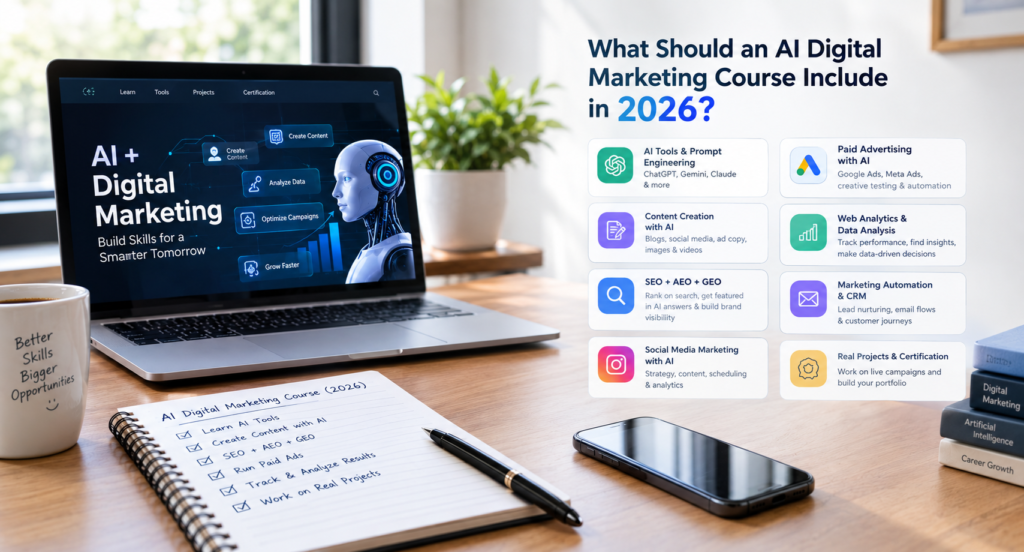
Digital marketing is changing faster than ever. AI is now influencing how businesses create content, analyze customers, run advertising campaigns, optimize websites, automate repetitive tasks, and reach audiences through search. That raises an important question for students, professionals, business owners, and career switchers: What should an AI digital marketing course include in 2026? A modern course should go far beyond teaching ChatGPT or a collection of AI tools. Students need to understand digital marketing fundamentals first and then learn how AI can improve strategy, execution, analysis, and automation. A strong AI-powered digital marketing course in 2026 should ideally cover SEO, AI search, content marketing, social media, Google Ads, analytics, marketing automation, AI tools, prompt engineering, customer research, conversion optimization, and practical projects. Google’s current guidance also reinforces that AI hasn’t eliminated the importance of SEO. Its generative AI search features continue to rely on core Search systems and foundational SEO practices. So, what exactly should students learn? Let’s break it down. What Should an AI Digital Marketing Course Include? A comprehensive AI digital marketing course in 2026 should include: Digital marketing fundamentals AI fundamentals for marketers Prompt engineering SEO and technical SEO AI search optimization AEO and GEO concepts Content marketing with AI Social media marketing Google Ads and paid advertising Email marketing Web analytics and GA4 Conversion rate optimization Marketing automation AI-powered customer research AI tools and workflows Personal branding and digital presence Local SEO and Google Business Profile Practical live projects AI-assisted marketing strategy Reporting and performance measurement The most important part is practical application. Students shouldn’t finish the course knowing only what AI tools are. They should know how to use those tools to solve real marketing problems. 1. Digital Marketing Fundamentals Before learning AI, students need to understand marketing. AI can generate a headline in seconds, but it cannot replace a marketer’s understanding of: Target audiences Customer journeys Buyer personas Marketing funnels Search intent Positioning Branding Conversion goals Customer pain points Competitive analysis A strong course should therefore begin with digital marketing fundamentals. Students should understand how different channels work together: SEO → Content → Social Media → Paid Ads → Email → Conversion → Analytics AI should then be introduced as a tool that can improve each part of this process. 2. AI Fundamentals for Digital Marketers An AI digital marketing course should explain the basics of generative AI in practical language. Students don’t necessarily need to become machine-learning engineers. They do need to understand concepts such as: Generative AI Large language models AI assistants Multimodal AI AI image generation AI video generation AI search Retrieval and grounding AI automation AI agents AI limitations Hallucinations Data privacy The objective should be simple: Understand what AI can do, what it cannot do, and where it fits into a marketing workflow. 3. Prompt Engineering for Marketers Prompting has become an important marketing skill. However, students shouldn’t simply memorize complicated prompt formulas. They should learn how to communicate marketing objectives clearly to AI tools. For example: Weak prompt Write a blog about SEO. Better prompt Create an outline for a 2,000-word SEO guide for small business owners who have basic marketing knowledge. Focus on practical steps, common mistakes, and measurable outcomes. Students should learn how to create prompts for: Content research Blog outlines SEO briefs Customer personas Ad copy Social media posts Email campaigns Competitor analysis Keyword research Content repurposing Marketing reports The important skill is not “prompt tricks.” It’s strategic prompting. 4. SEO in the Age of AI SEO should remain one of the core modules. Google’s 2026 guidance is particularly clear on this point: the fundamental SEO practices that help pages become crawlable, indexable, relevant, and useful continue to matter for generative AI features such as AI Overviews and AI Mode. An AI digital marketing course should therefore teach: Technical SEO Crawling Indexing Robots.txt XML sitemaps Canonical URLs Site architecture Core technical issues Mobile usability Page experience On-Page SEO Keyword research Search intent Title tags Meta descriptions Headings Internal linking Content optimization Image SEO Off-Page SEO Backlinks Digital PR Brand mentions Link quality Authority building Local SEO Google Business Profile Local citations Reviews Local landing pages Location-based content Students should learn how to use AI to assist SEO rather than blindly automate it. 5. AI Search, AEO and GEO This is one of the biggest areas that a 2026 course should add to a traditional digital marketing curriculum. Search is becoming increasingly conversational. Google’s AI Overviews and AI Mode use generative AI to help users explore complex questions and connect them with relevant web content. Students should understand: What is AI search? What are AI Overviews? What is Google AI Mode? What is AEO? What is GEO? How is AI search different from traditional search? How does search intent change in conversational queries? How can content become easier to understand and reference? How should brands measure AI-search visibility? Importantly, students should not be taught that there is a secret “GEO hack.” Google’s own 2026 guidance says there are no special AI-specific technical requirements for appearing in its AI search features; foundational SEO and helpful, people-first content remain the basis. For a deeper explanation, the course can reference: SEO vs AEO vs GEO: What Is the Difference in 2026? 6. AI-Powered Content Marketing Content marketing remains important, but the workflow is changing. Students should learn how AI can assist with: Topic research Content ideation Search-intent analysis Content briefs Outlines First drafts Editing Content optimization Repurposing Social content Email content Video scripts But they should also learn what not to do. Publishing hundreds of generic AI-generated articles is not a sustainable content strategy. Google’s current guidance emphasizes unique, valuable, non-commodity content and warns against creating large quantities of content primarily to manipulate search or generative AI visibility. Therefore, students should learn a workflow such as: AI research → Human expertise → Original insight → Editing → Fact-checking → SEO → Publishing → Measurement rather than: AI → Copy → Publish 7. Social Media Marketing With AI Social

What Should an AI Digital Marketing Course Include in 2026? Read More »
Can SEO Help Your Business Appear in ChatGPT and Gemini?

Can SEO Help Your Business Appear in ChatGPT and Gemini?

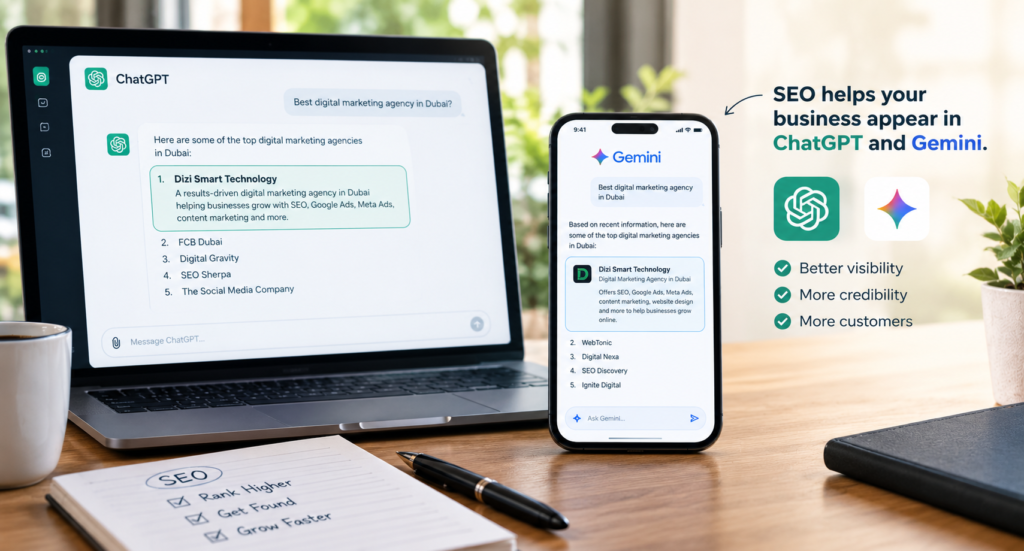
SEO is no longer only about ranking on Google. In 2026, businesses also need to think about how their content can be discovered, understood, and referenced by AI-powered search experiences such as ChatGPT and Gemini. But an important question remains: Can SEO actually help your business appear in ChatGPT and Gemini? The short answer is yes—but traditional SEO alone is not enough. Search engines and AI platforms use different systems to discover, understand, retrieve, and present information. However, many of the fundamentals that make a website useful for Google—such as crawlable content, clear information architecture, relevant topics, trustworthy information, strong pages, and useful answers—also help AI systems understand your business. Google itself has stated that its SEO best practices remain relevant for appearing in its generative AI search experiences. At the same time, ChatGPT Search can surface public websites and provide links to relevant sources. OpenAI recommends allowing its OAI-SearchBot to crawl your website if you want your content to be discoverable and potentially cited in ChatGPT search results. So, rather than thinking about SEO vs AI search, businesses should think about: SEO + helpful content + entity authority + AI-search readiness. Quick Answer: Does SEO Help You Appear in ChatGPT and Gemini? Yes, SEO can improve the chances that your business content is discovered and understood by AI-powered search systems. However, there is no guaranteed SEO technique that makes ChatGPT or Gemini mention your business. AI platforms may consider multiple signals, including: Whether your website can be crawled The relevance of your content to the user’s question The quality and usefulness of your information Your website’s topical authority Brand and business information available across the web Links and references from other reputable websites Clear website structure Fresh and accurate information Search intent and query context For ChatGPT specifically, OpenAI states that websites can appear in ChatGPT Search and recommends allowing OAI-SearchBot access for content that you want to be discoverable. Gemini can also provide sources and related links from public websites when available. What Is AI Search? AI search is an evolution of traditional search where users can ask questions in natural language and receive synthesized answers instead of simply receiving a list of blue links. For example, instead of searching: “Best digital marketing course in Varanasi” a user might ask: “Which digital marketing institute in Varanasi offers practical AI-focused training for beginners?” An AI-powered search experience may analyze information from multiple sources and generate a conversational response. This changes the way businesses need to approach search visibility. Your goal is no longer simply: “How do I rank #1 for this keyword?” It is increasingly: “How can I become a useful, trustworthy source for this topic?” This is where SEO, AEO, and GEO overlap. If you want to understand the difference, read our guide on SEO vs AEO vs GEO. How Does SEO Help With ChatGPT and Gemini? SEO can help AI systems in several important ways. 1. SEO Makes Your Website Easier to Discover Before an AI system can potentially use information from your website, the information needs to be accessible. A technically strong website helps search crawlers discover and process your pages. Important technical SEO elements include: Crawlable pages Indexable content Logical site architecture Descriptive URLs Internal links Fast and usable pages Mobile-friendly design Appropriate robots.txt configuration Proper canonicalization XML sitemap Accessible text content For ChatGPT Search, OpenAI specifically says that website owners should avoid blocking OAI-SearchBot if they want their content to be included in ChatGPT search summaries and snippets. This doesn’t mean allowing a crawler guarantees visibility. It simply removes one potential technical barrier. 2. SEO Helps Search Systems Understand Your Topics Search engines need to understand what your website is about. Suppose your website publishes one article about SEO, another about Google Ads, another about social media marketing, and another about email marketing—but there is no clear relationship between them. The site may have useful information, but its topical structure may be less obvious. A better approach is to build topic clusters. For example: Digital Marketing What Is Digital Marketing? Digital Marketing Strategies Digital Marketing Trends Digital Marketing Tools SEO What Is SEO? Technical SEO On-Page SEO Local SEO SEO Tools SEO vs AEO vs GEO AI Marketing AI in Digital Marketing AI SEO AI Search Optimization How to Appear in AI Search ChatGPT Search Optimization When related content is connected through contextual internal links, both users and search systems can better understand the relationship between your pages. 3. Helpful Content Gives AI Systems Something Valuable to Reference One of the biggest mistakes businesses make is creating content solely to target keywords. For example: “SEO Company in Varanasi | Best SEO Company | SEO Services Varanasi | SEO Expert Varanasi” repeated throughout an article doesn’t create meaningful value. Instead, answer the actual questions your audience asks. For example: What is SEO? How does SEO work? Can SEO increase website traffic? How long does SEO take? Can SEO help a website appear in AI search? How can a local business improve AI search visibility? This creates content that is useful beyond a single keyword. Google’s current guidance around generative AI features emphasizes useful, original content rather than producing large quantities of low-value pages simply because AI makes content creation easier. 4. Question-Based SEO Is Becoming More Important AI search is naturally conversational. Users ask: How does SEO work? Why isn’t my website ranking? How can my business appear in ChatGPT? How can I get mentioned in AI search? Does SEO still work in 2026? What is GEO? What is the difference between SEO and AEO? These questions create excellent opportunities for businesses to develop helpful content. Instead of writing one generic article called: “SEO Services” you could create supporting articles such as: How Long Does SEO Take to Show Results? Can SEO Help Small Businesses Grow? Why Is My Website Not Ranking on Google? Can SEO Help Your Business Appear in ChatGPT and Gemini? Is SEO Still Worth It in 2026? This creates a

Can SEO Help Your Business Appear in ChatGPT and Gemini? Read More »

SEO vs AEO vs GEO: What Is the Difference in 2026?

SEO vs AEO vs GEO: What Is the Difference in 2026?

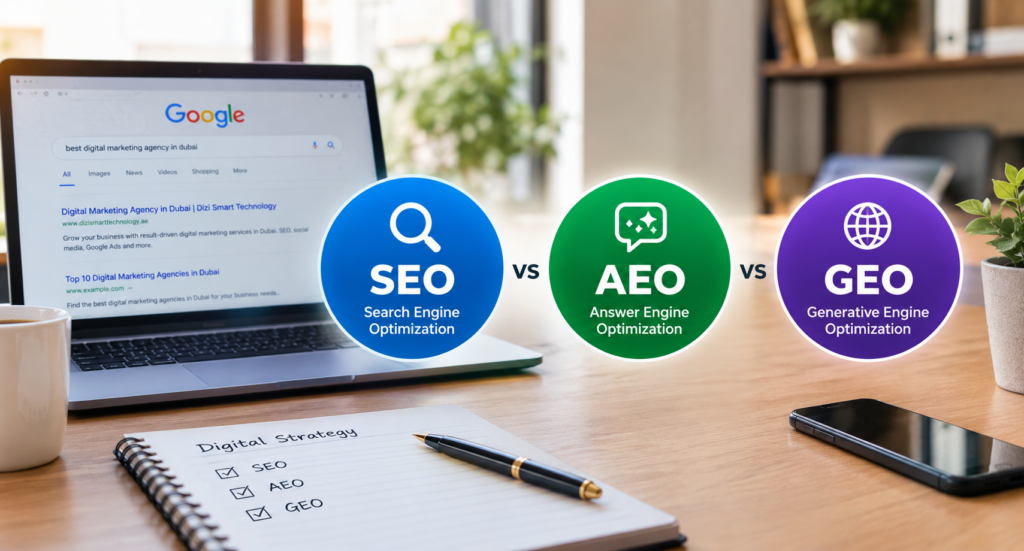
Search is changing. People no longer use Google only to type a few keywords, open ten blue links, and compare websites. They increasingly ask complete questions and expect direct answers from search engines and AI-powered platforms. Google now includes AI-powered experiences such as AI Overviews and AI Mode, while users are also discovering information through AI assistants and conversational search experiences. This has led to three terms becoming increasingly important in modern digital marketing: SEO — Search Engine Optimization AEO — Answer Engine Optimization GEO — Generative Engine Optimization But what is the difference between SEO, AEO and GEO? Are AEO and GEO replacing SEO? And if you are a business owner, marketer or SEO professional, which one should you focus on in 2026? Quick answer SEO helps your website become discoverable and competitive in traditional search results. AEO focuses on providing clear answers to questions so your content can be selected for answer-based search experiences. GEO focuses on improving the likelihood that your brand, content or expertise is represented in generative AI responses. They are not three completely separate strategies. In practice, strong SEO is the foundation, while AEO and GEO extend your search strategy into more conversational and AI-driven discovery experiences. SEO vs AEO vs GEO at a Glance Factor SEO AEO GEO Full form Search Engine Optimization Answer Engine Optimization Generative Engine Optimization Main goal Improve search visibility Provide direct answers Improve visibility in generative AI experiences Main focus Search engines and websites Questions and answers AI-generated responses Content style Comprehensive, useful content Concise, direct answers Authoritative, contextual, evidence-based content Typical query “digital marketing course” “What is digital marketing?” “Which digital marketing course is best for beginners?” Important signals Relevance, content quality, links, technical accessibility, experience Clear answers, structure, entities, question intent Authority, context, original information, brand/entity understanding Best approach Build search visibility Answer user questions Build trusted, citable expertise Relationship Foundation Extension of search strategy Extension into generative AI The important point: You do not need to choose only one. A modern search strategy can combine all three. What Is SEO? SEO, or Search Engine Optimization, is the process of improving a website and its content so that search engines can discover, understand and potentially rank its pages for relevant searches. SEO covers much more than inserting keywords into a blog. A strong SEO strategy can include: Keyword and search-intent research Technical SEO On-page SEO Internal linking Content optimization Website architecture Structured data Image and media optimization Digital PR and relevant backlinks Local SEO User experience Helpful, original content Performance measurement through tools such as Google Search Console and Analytics For example, if someone searches: “best digital marketing course in Varanasi” an SEO strategy would help a relevant Dizi Global Solution page become discoverable and competitive for that search. Dizi Global Solution’s digital marketing course page, for example, focuses on AI-powered digital marketing training, practical projects, SEO, Google Ads, social media marketing, AI tools and career support. SEO is still important in 2026 One of the biggest misconceptions about AI search is that SEO has become obsolete. It hasn’t. Google’s current documentation specifically explains that SEO best practices remain relevant for appearing in Google’s generative AI search experiences. That means businesses should not abandon SEO simply because users are increasingly interacting with AI-generated answers. Instead, they should build on their SEO foundation. What Is AEO? AEO stands for Answer Engine Optimization. AEO focuses on creating content that clearly addresses the questions users ask. Instead of optimizing only for a keyword such as: digital marketing course an AEO-focused strategy also considers questions such as: What is a digital marketing course? Is digital marketing a good career in 2026? What should I learn in digital marketing? How long does it take to learn digital marketing? Is AI replacing digital marketing jobs? This changes the content strategy from simply targeting keywords to understanding questions, entities, context and user intent. How does AEO work? AEO-friendly content generally makes answers easy to identify. For example: What is AEO? AEO is the practice of structuring and optimizing content so that it clearly answers users’ questions across answer-oriented search experiences. The answer is: Direct Accurate Contextually relevant Easy to understand Supported by useful detail The article can then expand on the answer. This structure helps both users and search systems understand the relationship between the question and the answer. What Is GEO? GEO stands for Generative Engine Optimization. GEO is used to describe strategies intended to improve how a brand, website, organization or source is represented within generative AI search and answer experiences. For example, a user might ask: “What are the best skills to learn for a digital marketing career in 2026?” Instead of receiving only a list of links, an AI-powered search experience may generate a synthesized response using information from multiple sources. The opportunity for a business is no longer limited to: “Can I rank for this keyword?” The bigger question becomes: “Can my website become a useful and trustworthy source for the answer?” This is where GEO enters the conversation. However, businesses should be careful with the idea that GEO is a secret set of ranking tricks. Google’s 2026 guidance specifically addresses common misconceptions around AEO/GEO and emphasizes that established SEO fundamentals remain relevant for generative AI features. SEO vs AEO: What Is the Difference? The simplest way to understand the difference is: SEO focuses on search visibility. AEO focuses on answer visibility. Traditional SEO might target: Digital Marketing Course in Varanasi AEO expands the strategy around questions such as: What is the best digital marketing course in Varanasi? How much does a digital marketing course cost? What skills are taught in a digital marketing course? Is digital marketing a good career? The two strategies overlap heavily. A page that is technically accessible, useful, relevant and well-structured can potentially perform well across multiple search experiences. SEO vs AEO example Imagine a digital marketing institute creates a page titled: Digital Marketing Course in Varanasi Traditional SEO can help the

SEO vs AEO vs GEO: What Is the Difference in 2026? Read More »