
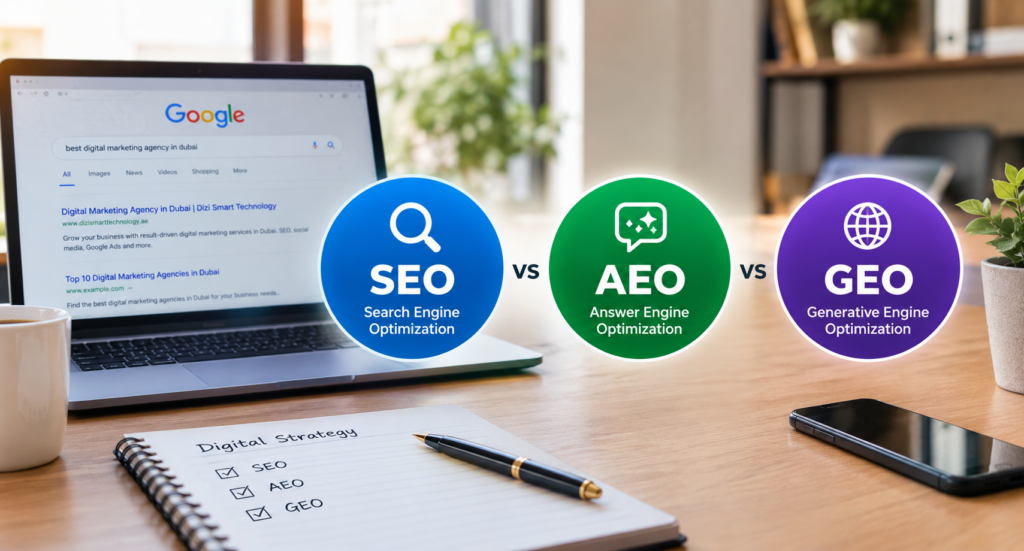
Search is changing.
People no longer use Google only to type a few keywords, open ten blue links, and compare websites. They increasingly ask complete questions and expect direct answers from search engines and AI-powered platforms.
Google now includes AI-powered experiences such as AI Overviews and AI Mode, while users are also discovering information through AI assistants and conversational search experiences.
This has led to three terms becoming increasingly important in modern digital marketing:
SEO — Search Engine Optimization
AEO — Answer Engine Optimization
GEO — Generative Engine Optimization
But what is the difference between SEO, AEO and GEO?
Are AEO and GEO replacing SEO?
And if you are a business owner, marketer or SEO professional, which one should you focus on in 2026?
Quick answer
SEO helps your website become discoverable and competitive in traditional search results. AEO focuses on providing clear answers to questions so your content can be selected for answer-based search experiences. GEO focuses on improving the likelihood that your brand, content or expertise is represented in generative AI responses.
They are not three completely separate strategies.
In practice, strong SEO is the foundation, while AEO and GEO extend your search strategy into more conversational and AI-driven discovery experiences.
SEO vs AEO vs GEO at a Glance
| Factor | SEO | AEO | GEO |
|---|---|---|---|
| Full form | Search Engine Optimization | Answer Engine Optimization | Generative Engine Optimization |
| Main goal | Improve search visibility | Provide direct answers | Improve visibility in generative AI experiences |
| Main focus | Search engines and websites | Questions and answers | AI-generated responses |
| Content style | Comprehensive, useful content | Concise, direct answers | Authoritative, contextual, evidence-based content |
| Typical query | “digital marketing course” | “What is digital marketing?” | “Which digital marketing course is best for beginners?” |
| Important signals | Relevance, content quality, links, technical accessibility, experience | Clear answers, structure, entities, question intent | Authority, context, original information, brand/entity understanding |
| Best approach | Build search visibility | Answer user questions | Build trusted, citable expertise |
| Relationship | Foundation | Extension of search strategy | Extension into generative AI |
The important point: You do not need to choose only one.
A modern search strategy can combine all three.
What Is SEO?
SEO, or Search Engine Optimization, is the process of improving a website and its content so that search engines can discover, understand and potentially rank its pages for relevant searches.
SEO covers much more than inserting keywords into a blog.
A strong SEO strategy can include:
- Keyword and search-intent research
- Technical SEO
- On-page SEO
- Internal linking
- Content optimization
- Website architecture
- Structured data
- Image and media optimization
- Digital PR and relevant backlinks
- Local SEO
- User experience
- Helpful, original content
- Performance measurement through tools such as Google Search Console and Analytics
For example, if someone searches:
“best digital marketing course in Varanasi”
an SEO strategy would help a relevant Dizi Global Solution page become discoverable and competitive for that search.
Dizi Global Solution’s digital marketing course page, for example, focuses on AI-powered digital marketing training, practical projects, SEO, Google Ads, social media marketing, AI tools and career support.
SEO is still important in 2026
One of the biggest misconceptions about AI search is that SEO has become obsolete.
It hasn’t.
Google’s current documentation specifically explains that SEO best practices remain relevant for appearing in Google’s generative AI search experiences.
That means businesses should not abandon SEO simply because users are increasingly interacting with AI-generated answers.
Instead, they should build on their SEO foundation.
What Is AEO?
AEO stands for Answer Engine Optimization.
AEO focuses on creating content that clearly addresses the questions users ask.
Instead of optimizing only for a keyword such as:
digital marketing course
an AEO-focused strategy also considers questions such as:
What is a digital marketing course?
Is digital marketing a good career in 2026?
What should I learn in digital marketing?
How long does it take to learn digital marketing?
Is AI replacing digital marketing jobs?
This changes the content strategy from simply targeting keywords to understanding questions, entities, context and user intent.
How does AEO work?
AEO-friendly content generally makes answers easy to identify.
For example:
What is AEO?
AEO is the practice of structuring and optimizing content so that it clearly answers users’ questions across answer-oriented search experiences.
The answer is:
- Direct
- Accurate
- Contextually relevant
- Easy to understand
- Supported by useful detail
The article can then expand on the answer.
This structure helps both users and search systems understand the relationship between the question and the answer.
What Is GEO?
GEO stands for Generative Engine Optimization.
GEO is used to describe strategies intended to improve how a brand, website, organization or source is represented within generative AI search and answer experiences.
For example, a user might ask:
“What are the best skills to learn for a digital marketing career in 2026?”
Instead of receiving only a list of links, an AI-powered search experience may generate a synthesized response using information from multiple sources.
The opportunity for a business is no longer limited to:
“Can I rank for this keyword?”
The bigger question becomes:
“Can my website become a useful and trustworthy source for the answer?”
This is where GEO enters the conversation.
However, businesses should be careful with the idea that GEO is a secret set of ranking tricks.
Google’s 2026 guidance specifically addresses common misconceptions around AEO/GEO and emphasizes that established SEO fundamentals remain relevant for generative AI features.
SEO vs AEO: What Is the Difference?
The simplest way to understand the difference is:
SEO focuses on search visibility.
AEO focuses on answer visibility.
Traditional SEO might target:
Digital Marketing Course in Varanasi
AEO expands the strategy around questions such as:
What is the best digital marketing course in Varanasi?
How much does a digital marketing course cost?
What skills are taught in a digital marketing course?
Is digital marketing a good career?
The two strategies overlap heavily.
A page that is technically accessible, useful, relevant and well-structured can potentially perform well across multiple search experiences.
SEO vs AEO example
Imagine a digital marketing institute creates a page titled:
Digital Marketing Course in Varanasi
Traditional SEO can help the page target relevant commercial searches.
But the page could also answer:
- What is digital marketing?
- Who can learn digital marketing?
- What modules are included?
- Is coding required?
- How long does the course take?
- What career options are available?
- What AI tools should students learn?
- What practical projects will students complete?
Now the same page satisfies both search intent and question-based intent.
AEO vs GEO: What Is the Difference?
AEO and GEO are closely related, but they are not identical concepts.
AEO
The focus is:
“How clearly can my content answer a user’s question?”
GEO
The focus is broader:
“How can my brand and expertise be represented accurately in generative AI experiences?”
AEO therefore tends to be more question-and-answer oriented.
GEO is more concerned with the broader AI discovery ecosystem, including:
- Brand/entity visibility
- Topical authority
- Context
- Original information
- Citability
- Trust
- Consistent brand information
- Expert perspectives
- Structured and accessible content
For example:
An AEO article might answer:
What is SEO?
A broader GEO strategy might build a complete topic ecosystem around:
- What is SEO?
- How does SEO work?
- Is SEO still important in 2026?
- SEO vs AEO vs GEO
- How does AI search affect SEO?
- How can businesses measure AI search visibility?
- What makes a website trustworthy?
The goal is to establish depth and authority around the subject, rather than relying on a single article.
SEO vs AEO vs GEO: Which One Is More Important in 2026?
The answer is:
You need all three — but SEO should remain the foundation.
Think of the strategy as a pyramid.
Level 1: SEO
Make your website:
- Crawlable
- Indexable
- Relevant
- Technically sound
- Well-structured
- Useful
- Authoritative
Level 2: AEO
Make your content:
- Question-focused
- Direct
- Structured
- Easy to understand
- Helpful for conversational searches
Level 3: GEO
Build:
- Brand authority
- Entity clarity
- Original insights
- Expertise
- Trusted sources
- Consistent information
- Strong topical coverage
This creates a broader AI-ready search strategy.
Does GEO Replace SEO?
No.
This is one of the biggest misconceptions surrounding AI search.
Google’s own 2026 guidance says SEO best practices continue to be relevant for success in generative AI search features.
AI-powered search still needs information from accessible web sources.
That means the fundamentals still matter:
- Can search systems access your page?
- Can they understand the content?
- Is the information useful?
- Is it relevant to the query?
- Does the page demonstrate expertise?
- Does your website provide unique value?
- Is your information trustworthy?
GEO should therefore be treated as an evolution of search visibility, not a magic replacement for SEO.
How to Optimize Your Website for SEO, AEO and GEO
A modern strategy should combine the three.
1. Start With Search Intent
Don’t begin with:
“What keyword should I put on this page?”
Start with:
“What does the user actually want to know or accomplish?”
For example:
Keyword: AI digital marketing course
Possible intents include:
- Course research
- Career research
- Skill development
- AI tools
- Certification
- Job opportunities
- Course comparison
One keyword can represent multiple intents.
Your content should identify the most relevant intent and satisfy it completely.
2. Answer the Main Question Early
If the article targets a question, don’t make users scroll through 1,000 words before finding the answer.
Give them a concise answer near the beginning.
Then explain the topic in depth.
This creates a better experience for users and makes the page easier to understand structurally.
3. Build Topic Clusters
Instead of publishing unrelated blogs, build interconnected topic clusters.
For example:
AI Search Cluster
Pillar article:
SEO vs AEO vs GEO: What Is the Difference in 2026?
Supporting articles:
- What Is AI Search Optimization?
- How Can a Business Appear in Google AI Overviews?
- How Do You Get Your Website Cited in ChatGPT Search?
- Is SEO Still Worth It in 2026?
- Will AI Replace SEO?
- How Can Local Businesses Improve AI Search Visibility?
- How to Optimize Content for AI Search?
Link these articles naturally to one another.
This gives search engines more context about the website’s expertise in the topic.
4. Create Original Information
This is especially important in the AI era.
Don’t simply ask an AI tool to rewrite information that already exists on ten other websites.
Google’s spam policies specifically warn against scaled content created primarily to manipulate search rankings, including large amounts of unoriginal AI-generated content that provides little additional value.
Instead, add:
- First-hand experience
- Examples
- Original analysis
- Case studies
- Screenshots
- Experiments
- Expert commentary
- Data
- Comparisons
- Practical processes
For a digital marketing agency, this can become a major competitive advantage.
5. Strengthen Internal Linking
Internal links help users discover related information and help search engines understand the relationship between pages.
For example, on Dizi Global Solution’s website, an article about SEO, AEO and GEO can naturally link to its relevant SEO course, AI-powered Digital Marketing Course, and Online Digital Marketing Course pages. Dizi’s current course pages already position these offerings around SEO, AI tools, practical projects and digital-marketing skills.
Recommended internal-link structure:
SEO vs AEO vs GEO
→ AI Digital Marketing Course
→ SEO Course
→ Online Digital Marketing Course
→ Digital Marketing Services
→ SEO Services
→ Google Ads Services
The links should be placed contextually rather than adding a large block of unrelated links at the end.
6. Build Strong Author and Brand Signals
AI search systems need context about the entities they encounter.
Your website should make it clear:
- Who is the company?
- What does it specialize in?
- Who are its experts?
- What services does it provide?
- What topics does it have expertise in?
- What original work has it produced?
- Where is it located?
- How can users contact it?
For Dizi Global Solution, this means consistently establishing the brand around both:
Digital Marketing Education + Digital Marketing Services
The current Dizi site already presents the business as a digital marketing institute and highlights AI-powered training, practical projects and industry-focused skills.
7. Use Structured Data Correctly
Structured data can help Google understand what a page represents.
Depending on the page, relevant structured data may include:
- Organization
- Article
- Breadcrumb
- Course
- LocalBusiness
- ProfilePage
Google explains that structured data helps it understand page content and supports certain search appearances.
However:
Schema is not a shortcut to AI visibility.
Don’t add structured data simply because you expect it to increase rankings.
Use the markup that accurately represents the page.
8. Make Content Easy to Extract and Understand
AI-friendly content doesn’t mean writing robotic content.
Instead:
- Use clear headings
- Give direct answers
- Explain terminology
- Use tables when comparisons are useful
- Use bullet points for processes
- Include examples
- Cite credible sources where appropriate
- Keep important information in crawlable text
- Avoid hiding essential information behind unnecessary scripts or interactions
The objective is simple:
Make the best answer easy to understand.
9. Don’t Create Content Just to “Rank in AI”
This is extremely important.
There is no guaranteed formula such as:
Add 10 FAQs + schema + 2,000 words = ChatGPT citation.
AI search visibility is not that predictable.
Google’s current documentation specifically warns against misconceptions around optimizing for generative AI features and emphasizes useful, non-commodity content.
Therefore, don’t create hundreds of pages simply because they contain AI-related keywords.
Create fewer, stronger resources.
10. Measure More Than Traditional Rankings
Traditional SEO reporting often focuses on:
- Rankings
- Impressions
- Clicks
- CTR
- Organic traffic
- Conversions
Modern search reporting should also consider:
- Brand mentions
- Search visibility
- Query coverage
- AI citations where measurable
- Referral traffic
- Branded searches
- Conversions from informational content
- Engagement with topic clusters
Google has also updated Search Console documentation around how AI Mode and AI Overviews are represented in Search performance reporting.
SEO vs AEO vs GEO: Which Strategy Should a Business Use?
Here’s a practical way to decide.
If your website has weak organic visibility:
Prioritize SEO first.
Fix technical issues, content quality, search intent, internal linking and authority.
If your website gets traffic but doesn’t answer questions well:
Add AEO.
Create direct answers around the questions your customers ask.
If your business wants stronger visibility across AI-powered discovery:
Expand toward GEO.
Build authoritative topical coverage, original insights, entity clarity and consistent brand information.
If you are serious about search in 2026:
Combine all three.
Example: How a Digital Marketing Institute Can Use SEO + AEO + GEO
Let’s take a real example.
Suppose Dizi Global Solution wants to increase visibility for its AI digital marketing training.
SEO strategy
Create and optimize:
AI Digital Marketing Course in Varanasi
Target relevant commercial searches and provide comprehensive information about the course.
AEO strategy
Answer questions such as:
- What is an AI digital marketing course?
- Who should learn AI digital marketing?
- What AI tools should digital marketers learn?
- Is AI digital marketing difficult to learn?
- Can beginners learn AI digital marketing?
- What jobs can I get after learning AI marketing?
GEO strategy
Build broader topical authority through:
- AI marketing guides
- AI SEO articles
- AI content marketing resources
- AI advertising guides
- Digital marketing case studies
- Original expert insights
- Practical AI marketing examples
Then connect these resources through internal links.
The result is not three separate SEO campaigns.
It is one integrated search strategy.
SEO vs AEO vs GEO: What Should You Focus on First?
If you’re starting from scratch, follow this order:
Step 1 — Build SEO foundations
Make sure Google can crawl, understand and index your website.
Step 2 — Understand search intent
Identify what users actually want when they search.
Step 3 — Create helpful content
Answer the user’s question better than generic competing content.
Step 4 — Add question-focused content
Build AEO-style sections and supporting articles.
Step 5 — Build topical authority
Create interconnected content around important subjects.
Step 6 — Strengthen brand/entity signals
Make your business, experts and areas of expertise clear.
Step 7 — Add original insights
Use real experience, examples, data and case studies.
Step 8 — Measure and improve
Use Search Console, analytics and business conversion data to identify what is working.
Frequently Asked Questions
Is AEO replacing SEO?
No. AEO should be viewed as an extension of a modern search strategy rather than a replacement for SEO. Strong technical SEO, useful content and accessibility remain important for search visibility.
Is GEO the same as AEO?
No. AEO primarily focuses on answering questions clearly, while GEO is a broader concept focused on improving how a brand or its information may be represented in generative AI experiences.
Is SEO still important in 2026?
Yes. Google continues to state that SEO best practices remain relevant for its generative AI search experiences.
Can AI-generated content rank on Google?
AI-assisted content can appear in Search, but using AI to mass-produce low-value, unoriginal pages for ranking purposes can violate Google’s spam policies. The focus should be on creating helpful, original content regardless of how it was produced.
How do I optimize my website for AI search?
Start with strong SEO fundamentals, create useful and original content, answer relevant questions clearly, establish topical authority, make your business and expertise clear, and provide information that genuinely helps users.
Does schema guarantee AI visibility?
No. Structured data helps search engines understand eligible content and can support certain search appearances, but schema alone does not guarantee rankings or inclusion in AI-generated answers.
What is more important: SEO, AEO or GEO?
There is no universal winner. For most businesses, the best approach is SEO as the foundation, AEO for question-based visibility, and GEO as part of a broader AI-search strategy.
Should small businesses invest in AEO and GEO?
Yes, but they should not ignore SEO fundamentals. Small businesses can benefit by creating highly specific, useful content that demonstrates real expertise and directly answers customer questions.
Final Takeaway
The future of search isn’t simply:
SEO → AEO → GEO → SEO becomes obsolete.
It is more accurately:
SEO + AEO + GEO = A broader search visibility strategy.
SEO helps your website become discoverable.
AEO helps your content answer questions clearly.
GEO focuses attention on visibility within generative AI experiences.
The businesses most likely to benefit from the changing search landscape won’t be the ones trying to find a single “AI ranking trick.”
They will be the ones consistently producing useful, original, authoritative and easy-to-understand information.
And that is why SEO is not disappearing in 2026.
SEO is evolving.
For businesses and professionals who want to stay ahead of this shift, learning traditional SEO alongside AI-powered digital marketing, content strategy and modern search optimization can provide a much stronger foundation for the future.
Explore Dizi Global Solution’s AI Digital Marketing Course to learn modern SEO, AI marketing, content, advertising and practical digital-marketing skills.
You can also explore the Online Digital Marketing Course for flexible digital-marketing training with practical learning and live guidance.