
Digital marketing is changing faster than ever.
AI is now influencing how businesses create content, analyze customers, run advertising campaigns, optimize websites, automate repetitive tasks, and reach audiences through search.
That raises an important question for students, professionals, business owners, and career switchers:
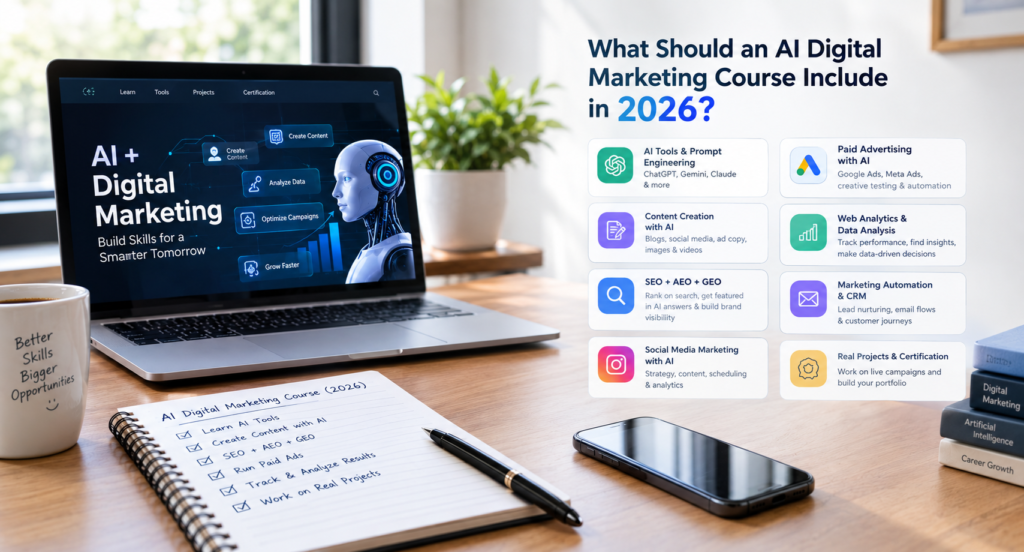
What should an AI digital marketing course include in 2026?
A modern course should go far beyond teaching ChatGPT or a collection of AI tools. Students need to understand digital marketing fundamentals first and then learn how AI can improve strategy, execution, analysis, and automation.
A strong AI-powered digital marketing course in 2026 should ideally cover SEO, AI search, content marketing, social media, Google Ads, analytics, marketing automation, AI tools, prompt engineering, customer research, conversion optimization, and practical projects.
Google’s current guidance also reinforces that AI hasn’t eliminated the importance of SEO. Its generative AI search features continue to rely on core Search systems and foundational SEO practices.
So, what exactly should students learn?
Let’s break it down.
What Should an AI Digital Marketing Course Include?
A comprehensive AI digital marketing course in 2026 should include:
- Digital marketing fundamentals
- AI fundamentals for marketers
- Prompt engineering
- SEO and technical SEO
- AI search optimization
- AEO and GEO concepts
- Content marketing with AI
- Social media marketing
- Google Ads and paid advertising
- Email marketing
- Web analytics and GA4
- Conversion rate optimization
- Marketing automation
- AI-powered customer research
- AI tools and workflows
- Personal branding and digital presence
- Local SEO and Google Business Profile
- Practical live projects
- AI-assisted marketing strategy
- Reporting and performance measurement
The most important part is practical application.
Students shouldn’t finish the course knowing only what AI tools are. They should know how to use those tools to solve real marketing problems.
1. Digital Marketing Fundamentals
Before learning AI, students need to understand marketing.
AI can generate a headline in seconds, but it cannot replace a marketer’s understanding of:
- Target audiences
- Customer journeys
- Buyer personas
- Marketing funnels
- Search intent
- Positioning
- Branding
- Conversion goals
- Customer pain points
- Competitive analysis
A strong course should therefore begin with digital marketing fundamentals.
Students should understand how different channels work together:
SEO → Content → Social Media → Paid Ads → Email → Conversion → Analytics
AI should then be introduced as a tool that can improve each part of this process.
2. AI Fundamentals for Digital Marketers
An AI digital marketing course should explain the basics of generative AI in practical language.
Students don’t necessarily need to become machine-learning engineers.
They do need to understand concepts such as:
- Generative AI
- Large language models
- AI assistants
- Multimodal AI
- AI image generation
- AI video generation
- AI search
- Retrieval and grounding
- AI automation
- AI agents
- AI limitations
- Hallucinations
- Data privacy
The objective should be simple:
Understand what AI can do, what it cannot do, and where it fits into a marketing workflow.
3. Prompt Engineering for Marketers
Prompting has become an important marketing skill.
However, students shouldn’t simply memorize complicated prompt formulas.
They should learn how to communicate marketing objectives clearly to AI tools.
For example:
Weak prompt
Write a blog about SEO.
Better prompt
Create an outline for a 2,000-word SEO guide for small business owners who have basic marketing knowledge. Focus on practical steps, common mistakes, and measurable outcomes.
Students should learn how to create prompts for:
- Content research
- Blog outlines
- SEO briefs
- Customer personas
- Ad copy
- Social media posts
- Email campaigns
- Competitor analysis
- Keyword research
- Content repurposing
- Marketing reports
The important skill is not “prompt tricks.”
It’s strategic prompting.
4. SEO in the Age of AI
SEO should remain one of the core modules.
Google’s 2026 guidance is particularly clear on this point: the fundamental SEO practices that help pages become crawlable, indexable, relevant, and useful continue to matter for generative AI features such as AI Overviews and AI Mode.
An AI digital marketing course should therefore teach:
Technical SEO
- Crawling
- Indexing
- Robots.txt
- XML sitemaps
- Canonical URLs
- Site architecture
- Core technical issues
- Mobile usability
- Page experience
On-Page SEO
- Keyword research
- Search intent
- Title tags
- Meta descriptions
- Headings
- Internal linking
- Content optimization
- Image SEO
Off-Page SEO
- Backlinks
- Digital PR
- Brand mentions
- Link quality
- Authority building
Local SEO
- Google Business Profile
- Local citations
- Reviews
- Local landing pages
- Location-based content
Students should learn how to use AI to assist SEO rather than blindly automate it.
5. AI Search, AEO and GEO
This is one of the biggest areas that a 2026 course should add to a traditional digital marketing curriculum.
Search is becoming increasingly conversational.
Google’s AI Overviews and AI Mode use generative AI to help users explore complex questions and connect them with relevant web content.
Students should understand:
- What is AI search?
- What are AI Overviews?
- What is Google AI Mode?
- What is AEO?
- What is GEO?
- How is AI search different from traditional search?
- How does search intent change in conversational queries?
- How can content become easier to understand and reference?
- How should brands measure AI-search visibility?
Importantly, students should not be taught that there is a secret “GEO hack.”
Google’s own 2026 guidance says there are no special AI-specific technical requirements for appearing in its AI search features; foundational SEO and helpful, people-first content remain the basis.
For a deeper explanation, the course can reference:
SEO vs AEO vs GEO: What Is the Difference in 2026?
6. AI-Powered Content Marketing
Content marketing remains important, but the workflow is changing.
Students should learn how AI can assist with:
- Topic research
- Content ideation
- Search-intent analysis
- Content briefs
- Outlines
- First drafts
- Editing
- Content optimization
- Repurposing
- Social content
- Email content
- Video scripts
But they should also learn what not to do.
Publishing hundreds of generic AI-generated articles is not a sustainable content strategy.
Google’s current guidance emphasizes unique, valuable, non-commodity content and warns against creating large quantities of content primarily to manipulate search or generative AI visibility.
Therefore, students should learn a workflow such as:
AI research → Human expertise → Original insight → Editing → Fact-checking → SEO → Publishing → Measurement
rather than:
AI → Copy → Publish
7. Social Media Marketing With AI
Social media should also be part of an AI digital marketing curriculum.
Students should learn how AI can support:
- Content calendars
- Caption creation
- Content ideas
- Audience research
- Competitor analysis
- Hashtag research
- Short-form video scripts
- Reels ideas
- Community management
- Social listening
- Content repurposing
For example, one long-form blog could become:
1 Blog
↓
5 LinkedIn posts
↓
5 Instagram posts
↓
3 short-video scripts
↓
1 email newsletter
↓
10 short social posts
AI can significantly accelerate this repurposing workflow.
8. Google Ads and AI-Powered Advertising
Paid advertising should remain a major part of the course.
Students should understand:
- Campaign structure
- Search campaigns
- Keyword targeting
- Match types
- Ad copy
- Landing pages
- Conversion tracking
- Audience targeting
- Remarketing
- Budget management
- Campaign optimization
AI can then be introduced for:
- Ad copy variations
- Keyword clustering
- Audience research
- Creative ideation
- Campaign analysis
- Performance summaries
- Testing ideas
The goal should be to teach students how to make decisions, not simply how to generate advertisements.
9. Analytics and Marketing Measurement
One of the biggest gaps in many beginner marketing courses is analytics.
Students should understand how to answer:
“Did the campaign actually work?”
A modern course should cover:
- Google Analytics 4
- Google Search Console
- Conversion tracking
- UTM parameters
- Traffic analysis
- Engagement
- Lead tracking
- Conversion rates
- Customer acquisition cost
- Return on ad spend
- Marketing ROI
AI can then help marketers analyze large datasets and turn performance data into actionable insights.
For example:
“Organic traffic increased by 32%, but leads increased by only 8%. What could explain the difference?”
That’s a much more valuable AI use case than simply asking AI to “write a report.”
10. Conversion Rate Optimization
Getting traffic isn’t enough.
Students should understand how to turn traffic into:
- Leads
- Calls
- Sign-ups
- Purchases
- Bookings
- Enquiries
A modern course should cover:
- Landing-page optimization
- CTA optimization
- Form optimization
- A/B testing
- User experience
- Trust signals
- Social proof
- Offer positioning
- Conversion funnels
AI can help analyze customer objections, generate testing hypotheses, and identify potential friction points.
11. Marketing Automation
AI becomes significantly more valuable when combined with automation.
Students should learn how to connect marketing tasks into workflows.
For example:
Lead Form
↓
CRM
↓
AI Lead Classification
↓
Personalized Email
↓
Sales Notification
↓
Follow-Up
↓
Reporting
Students can explore automation platforms and integrations to understand how AI can reduce repetitive manual work.
12. AI-Powered Customer Research
One of the most valuable uses of AI is research.
Students should learn how to use AI to analyze:
- Customer reviews
- Survey responses
- Competitor messaging
- Reddit discussions
- Social comments
- Search queries
- Customer complaints
- Product feedback
For example, an AI workflow could analyze hundreds of customer reviews and identify recurring themes:
- Price concerns
- Delivery concerns
- Quality concerns
- Feature requests
- Customer expectations
Those insights can then influence:
- SEO content
- Ad copy
- Product pages
- Landing pages
- Social media
- Email campaigns
13. AI Image and Video Creation
Visual content is now an important marketing skill.
An AI digital marketing course should introduce students to responsible AI-assisted creation of:
- Social graphics
- Ad creatives
- Product images
- Presentation visuals
- Short videos
- Video scripts
- Storyboards
- Thumbnails
However, students should also learn brand consistency and quality control.
AI should accelerate creative production—not eliminate creative thinking.
14. Personal Branding With AI
Personal branding is increasingly important for marketers.
Students should learn how to build a professional presence across platforms such as:
- YouTube
- Personal websites
- Industry communities
AI can help with:
- Content ideas
- Post creation
- Video scripts
- Research
- Content calendars
- Repurposing
- Profile optimization
But the strongest personal brands still require real expertise, opinions, experience, and original perspectives.
15. Local SEO and Google Business Profile
For students working with local businesses, local SEO should be a dedicated module.
Students should learn:
- Google Business Profile optimization
- Local keyword research
- Local landing pages
- Reviews
- Local citations
- NAP consistency
- Local content
- Maps visibility
- Local competitor research
Google’s AI-search guidance also recommends keeping Business Profile information up to date where relevant.
This makes local SEO particularly useful for students working with restaurants, clinics, educational institutes, agencies, retailers, and service businesses.
16. AI Tools Should Be Taught as Workflows, Not Just a Tool List
A common mistake is creating an “AI tools” module containing 30 or 50 tools.
That isn’t necessarily useful.
Tools change rapidly.
Instead, students should learn categories and workflows.
For example:
| Marketing Task | AI Skill |
|---|---|
| Research | AI-assisted research |
| Content | AI-assisted content workflow |
| SEO | AI-assisted SEO analysis |
| Ads | AI-assisted campaign optimization |
| Social | AI content planning |
| Design | AI creative generation |
| Analytics | AI data interpretation |
| Automation | AI workflow automation |
| Customer service | AI-assisted response systems |
The course should teach students how to evaluate new tools as they emerge.
That’s more future-proof than memorizing software interfaces.
17. Ethics, Privacy and Responsible AI
This module is increasingly important.
Students should understand:
- Copyright considerations
- Data privacy
- Confidential information
- AI hallucinations
- Fact-checking
- Disclosure
- Bias
- Brand safety
- Human review
- Responsible automation
AI output should never automatically be assumed to be accurate.
Students should develop the habit:
Generate → Verify → Improve → Approve
18. Practical Projects Should Be Mandatory
This is perhaps the most important part.
An AI digital marketing course should not end with theory.
Students should complete real projects.
For example:
Project 1: SEO Audit
Audit an existing website and identify:
- Technical issues
- Content gaps
- Keyword opportunities
- Internal-link opportunities
Project 2: AI Content Strategy
Create a 3-month content strategy based on:
- Audience
- Search intent
- Competitors
- Topic clusters
Project 3: Google Ads Campaign
Build a sample campaign including:
- Keywords
- Ads
- Landing page
- Conversion goals
- Budget
Project 4: AI Search Strategy
Analyze how a business could improve its visibility across:
- Google Search
- AI Overviews
- AI Mode
- Conversational search
Project 5: Complete Marketing Campaign
Students create an end-to-end campaign:
Research → Strategy → Content → SEO → Ads → Social → Analytics → Optimization
This is much more valuable for employability than a certificate alone.
19. Portfolio Building and Career Preparation
A course should help students leave with evidence of what they can actually do.
A strong portfolio might include:
- SEO audit
- Keyword research project
- Content strategy
- Blog article
- Google Ads campaign
- Social media campaign
- Analytics report
- AI marketing workflow
- Case study
- Landing-page optimization project
Students can then use these projects when applying for:
- SEO roles
- Digital marketing jobs
- Performance marketing positions
- Content marketing roles
- Social media jobs
- Marketing analyst positions
- Freelance projects
- Agency roles
The question employers increasingly care about is not only:
“Did you complete a digital marketing course?”
but:
“What can you actually do?”
20. What Makes an AI Digital Marketing Course Different From a Traditional Course?
A traditional digital marketing course may teach:
SEO + Social Media + Google Ads + Email + Analytics
An AI-focused 2026 course should teach:
SEO + Social Media + Ads + Analytics + AI + Automation + AI Search + Practical Projects
The difference isn’t simply adding ChatGPT to every module.
It’s changing the way marketers work.
Traditional workflow
Research → Manual execution → Manual analysis
AI-assisted workflow
Research → AI-assisted analysis → Human strategy → AI-assisted execution → Human review → Automation → Measurement
The marketer remains responsible for strategy and quality.
21. How AI Changes the Skills Employers Look For
Digital marketers don’t necessarily need to become AI engineers.
But they increasingly need to become AI-fluent marketers.
Important skills include:
Strategic thinking
Understanding what the business actually needs.
Analytical thinking
Interpreting data instead of simply generating reports.
Content judgment
Knowing whether content is useful, accurate, original, and relevant.
AI literacy
Understanding how AI tools work and where they fit.
Automation
Identifying repetitive processes that can be automated.
SEO
Understanding how search visibility works across traditional and AI-powered search.
Communication
Explaining strategies and results clearly.
Adaptability
Learning new tools and workflows as technology changes.
22. How Long Should an AI Digital Marketing Course Be?
There isn’t one correct duration.
The quality of the curriculum matters more than the number of weeks.
A comprehensive program might be structured as:
Foundation
Digital marketing fundamentals
Core Marketing
SEO, social media, paid advertising, content and email
AI Marketing
Generative AI, prompting, AI content, AI research and AI creative tools
AI Search
AI Overviews, AI Mode, AEO, GEO and conversational search
Analytics
GA4, Search Console, reporting and conversion measurement
Automation
AI workflows and marketing automation
Projects
Real campaigns and portfolio development
This structure creates a learning path instead of simply presenting students with a list of tools.
What Should You Look for Before Joining an AI Digital Marketing Course?
Before enrolling, ask these questions:
1. Does the course include practical projects?
If the entire course is theory, think twice.
2. Does it teach SEO?
AI hasn’t made SEO irrelevant. Google’s current guidance explicitly says foundational SEO remains relevant to generative AI search.
3. Does it teach AI search?
A 2026 curriculum should discuss AI Overviews, AI Mode, conversational search and related concepts.
4. Does it teach analytics?
Without measurement, marketing becomes guesswork.
5. Does it teach automation?
Students should understand how AI can reduce repetitive work.
6. Does it build a portfolio?
Projects are valuable evidence of practical ability.
7. Does the curriculum evolve?
AI marketing changes quickly. A good course should be updated rather than relying on an outdated tool list.
Why an AI Digital Marketing Course Can Be Valuable in 2026
AI is changing the execution layer of marketing.
Tasks that previously required significant manual effort can now be accelerated with AI.
But this doesn’t make marketing knowledge less important.
It makes marketing judgment more important.
A marketer who understands:
Audience + Strategy + SEO + Content + Ads + Analytics + AI + Automation
can potentially work more efficiently than someone who knows only individual tools.
That’s why the best AI digital marketing courses should focus on skills, workflows, strategy, and practical execution.
Frequently Asked Questions
What is an AI digital marketing course?
An AI digital marketing course teaches traditional digital marketing skills such as SEO, social media, paid advertising, content and analytics while showing students how AI can improve research, execution, optimization and automation.
What should an AI digital marketing course include in 2026?
It should ideally include SEO, AI search, content marketing, social media, Google Ads, analytics, automation, prompt engineering, AI tools, conversion optimization, local SEO and practical projects.
Is SEO still important in an AI digital marketing course?
Yes. Google states that foundational SEO practices remain relevant to its generative AI search features, including AI Overviews and AI Mode.
Should an AI digital marketing course teach ChatGPT?
Yes, but ChatGPT should be taught as part of a broader AI marketing workflow rather than as the entire curriculum.
Students should learn how to use AI for research, content, analysis, strategy, automation and productivity.
Is AI going to replace digital marketers?
AI is changing many marketing tasks, but marketers still need strategy, judgment, creativity, communication, analysis and business understanding.
The more useful question is:
How can marketers use AI to become more effective?
Is an AI digital marketing course suitable for beginners?
Yes, provided the course starts with digital marketing fundamentals and gradually introduces AI.
Beginners shouldn’t be expected to understand advanced AI concepts before learning how marketing itself works.
Final Thoughts
An AI digital marketing course in 2026 should not be a traditional digital marketing course with one extra module called “ChatGPT.”
It should teach students how modern marketing actually works.
The technology will continue changing. Today’s popular AI tool may be replaced by another tool next year.
But the underlying skills—understanding customers, creating useful content, building visibility, analyzing data, improving conversions, and developing marketing strategies—will continue to matter.
That is why the best AI digital marketing education should teach students how to think like marketers and use AI as leverage, rather than simply teaching them which buttons to click.
If you’re looking for structured training that combines AI with practical digital marketing skills, explore Dizi Global Solution’s AI-powered digital marketing course or its online digital marketing course.